Apollo 11: the day humanity touched the moon
Apollo 11 marked a historic milestone in space exploration, successfully landing humans on the moon on July 20, 1969. This mission, featuring astronauts Neil Armstrong and Buzz Aldrin, showcased human ingenuity and sparked global interest in science and technology. Their famous moonwalk changed our understanding of space travel and inspired future generations to explore beyond Earth. The achievement united humanity around the goals of exploration and discovery, emphasizing teamwork and innovation.
The Apollo 11 mission marked a defining moment in history, forever altering humanity’s relationship with space. What did it take for us to touch the moon? Let’s dive into the epic journey!
Introduction to Apollo 11
The Apollo 11 mission was a remarkable journey for mankind. Launched on July 16, 1969, it aimed to land humans on the moon. It was a bold step into the unknown, sparking excitement and curiosity across the globe.
The spacecraft carried three astronauts: Neil Armstrong, Buzz Aldrin, and Michael Collins. Each played a vital role in making history. Armstrong and Aldrin became the first men to walk on the moon on July 20, 1969.
This mission was part of the larger space race during the Cold War. The United States wanted to showcase its technological strength. Landing on the moon was not just a goal, it was a statement.
As the Lunar Module separated from the Command Module, the world held its breath. Armstrong’s famous words, “That’s one small step for man, one giant leap for mankind,” resonated far and wide. Their steps on the lunar surface marked an amazing achievement in human history.
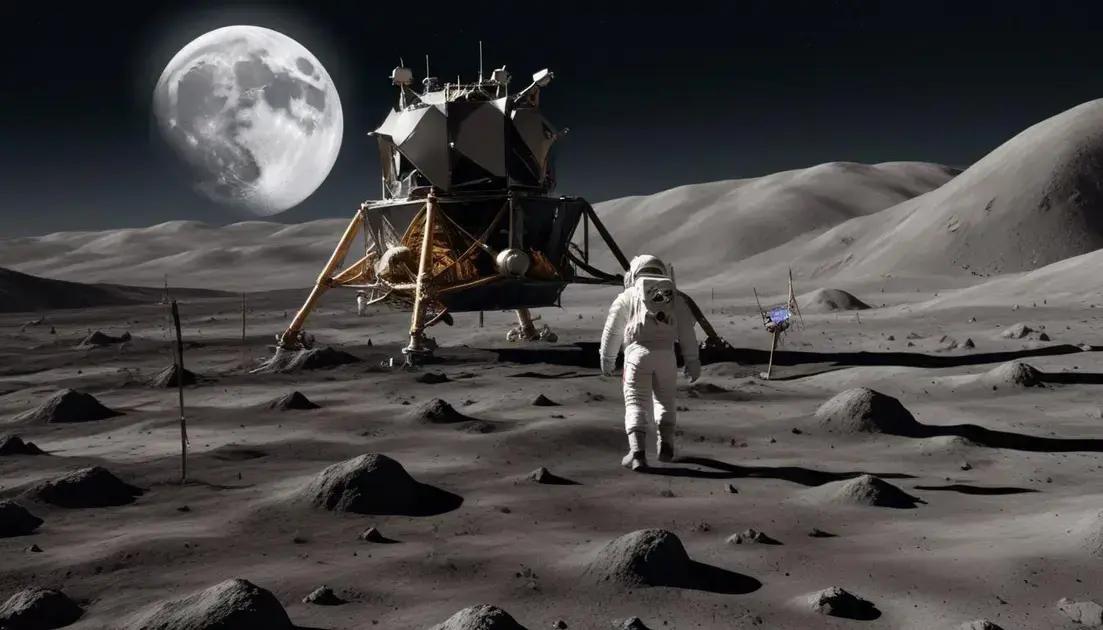
Many wonder what it was like up there. The moon was barren but beautiful, with Earth visible in the sky. The adventure was full of scientific exploration and human bravery.
The success of Apollo 11 opened the door for future missions. It inspired generations to dream big and explore further. The mission remains a symbol of human achievement and curiosity.
The launch and mission details
The Apollo 11 mission was launched on July 16, 1969. It used a powerful rocket called the Saturn V. This rocket was the largest ever built, standing 363 feet tall. It could carry heavy loads into space.
The mission had three astronauts: Neil Armstrong, Buzz Aldrin, and Michael Collins. Armstrong was the commander and the first man to step on the moon. Aldrin followed him, making history too. Collins stayed in orbit around the moon in the Command Module.
The launch pad was Kennedy Space Center in Florida. Millions watched the countdown and lift-off on TV. The excitement was electric! Everyone was eager to see if they could land on the moon.
After launch, the crew traveled for about four days. They flew more than 240,000 miles to reach the moon. During the journey, they performed important checks on their spacecraft. Everything must work perfectly for the landing.
On July 19, they entered the moon’s orbit. The Lunar Module, named Eagle, separated from the Command Module, Columbia. This marked the beginning of the final steps toward the moon landing.
The Eagle descended to the lunar surface. As it got closer, Armstrong had to pilot it manually due to rough terrain. It touched down on July 20, 1969, in an area called Sea of Tranquility.
That moment was a huge achievement for all mankind. The mission showed that humans could travel beyond Earth and explore other worlds.
The landing of the lunar module
The Lunar Module, named Eagle, began its descent to the moon on July 20, 1969. This was an exciting moment for everyone watching from Earth. All eyes were on the spacecraft as it approached the surface.
As Eagle came closer, Neil Armstrong piloted the craft. It had to land in a safe spot, but the terrain was tricky. Armstrong needed to find a flat area to touch down safely.
They faced some challenges during the landing. Fuel was running low, and Armstrong had to take control manually. The view from the window showed craters and bumps everywhere. It was a delicate balance of skill and timing.
At 2:56 AM UTC, Armstrong reported, “The Eagle has landed!” This was thrilling news. The mission had made it to the moon!
After landing, the astronauts prepared to step onto the lunar surface. They checked their equipment and suited up for the first moonwalk. The moment was about to change history forever.
When the hatch opened, Armstrong took his famous first step onto the moon. He felt a mix of excitement and responsibility. They were not just there for themselves; they were representing all of humanity.
The lunar surface was dusty and gray, unlike anything they had seen. Armstrong and Buzz Aldrin explored the area, collecting samples and taking photographs. This marked a key moment in space exploration history.
First steps on the moon
The moment finally arrived on July 20, 1969, when Neil Armstrong stepped onto the moon. His first words were, “That’s one small step for [a] man, one giant leap for mankind.” Everyone on Earth listened closely.
Armstrong’s first steps were carefully planned. He tested the moon’s surface. Would it hold his weight? The ground felt soft and powdery. He took slow steps to avoid any slips.
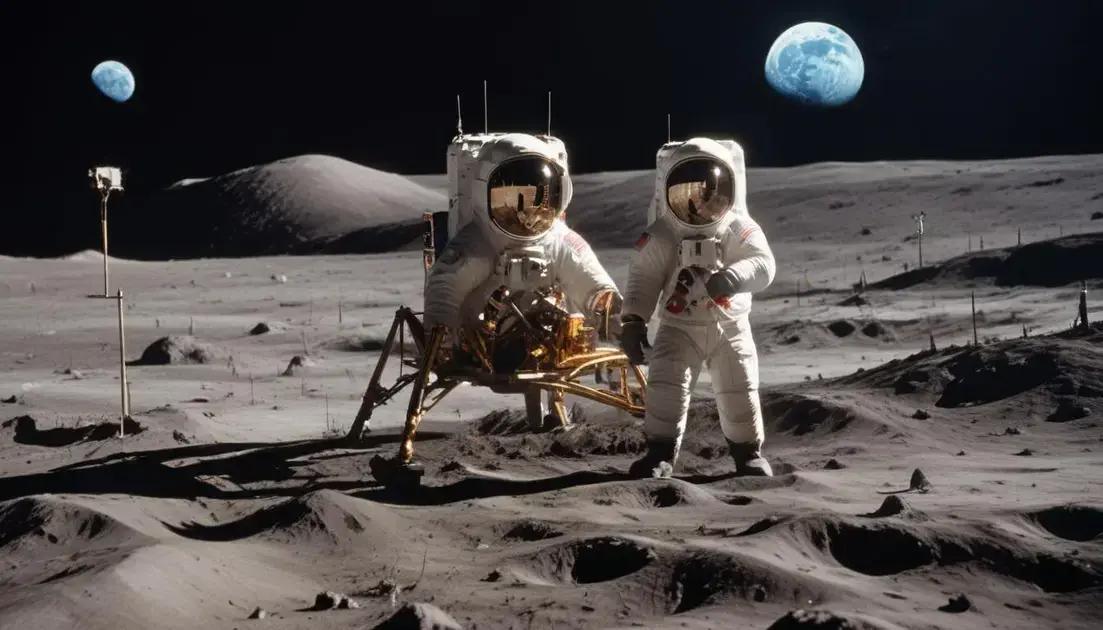
Buzz Aldrin joined him shortly after. They looked around in awe. The moon was barren, yet beautiful. Earth hung in the sky like a blue marble.
During their moonwalk, they took photographs of their surroundings. They wanted to capture everything they saw. The scene was unlike anything humans had ever experienced.
The astronauts collected samples of lunar rocks and dust. This information was crucial for scientists on Earth. It would help them learn about the moon’s history.
Armstrong and Aldrin also planted the American flag. This symbolized their achievement and humanity’s reach into space. It was a proud moment for everyone back home.
They performed experiments too. One experiment tested how well a hammer and feather would fall on the moon. It showed that gravity is weaker on the moon.
Every step they took was a step into the future. Their exploration proved that humans could travel to another world. It inspired generations to dream big and explore further.
Return and impact of Apollo 11
The return of Apollo 11 was as thrilling as the launch. After spending about eight days in space, the astronauts headed back to Earth. They were eager to share their experience with everyone.
As they re-entered the Earth’s atmosphere, the spacecraft faced extreme heat. The walls reached temperatures over 3,000 degrees Fahrenheit. But the heat shield worked perfectly, protecting the crew inside.
On July 24, 1969, Apollo 11 splashed down in the Pacific Ocean. It was a successful landing! A Navy recovery team was waiting to rescue the astronauts.
The astronauts were picked up by a helicopter and flown to the USS Hornet aircraft carrier. Everyone cheered as they stepped onto the ship. They were heroes, returning from an extraordinary adventure.
The mission had a huge impact. It not only showed that humans could land on the moon, but it also inspired a generation. Young people dreamed of becoming astronauts and scientists.
Back on Earth, the Apollo 11 crew shared their stories with the world. They gave interviews and participated in parades. Their mission sparked interest in space exploration and science.
The success of Apollo 11 also led to further missions. NASA used what they learned to improve technology and safety for future space travel. People realized the importance of exploring beyond our planet.
Overall, Apollo 11 changed the way we see space. It united people around a common goal and showed what humans can achieve together.
Conclusion
In conclusion, Apollo 11 was a landmark mission that changed our understanding of space travel. By landing on the moon, Neil Armstrong and Buzz Aldrin showed us that human exploration is possible beyond Earth. Their journey inspired millions and sparked interest in science and technology.
The return of the astronauts also had a lasting impact on society. It united people around a common goal and fostered a desire to explore the unknown. Apollo 11 demonstrated the power of teamwork and innovation. It encouraged future generations to pursue careers in STEM fields.
As we look back on this historic event, we remember the importance of curiosity and exploration. Each step taken by the Apollo 11 team opened doors to new possibilities. Their achievement reminds us that, with dedication and effort, we can reach new heights.