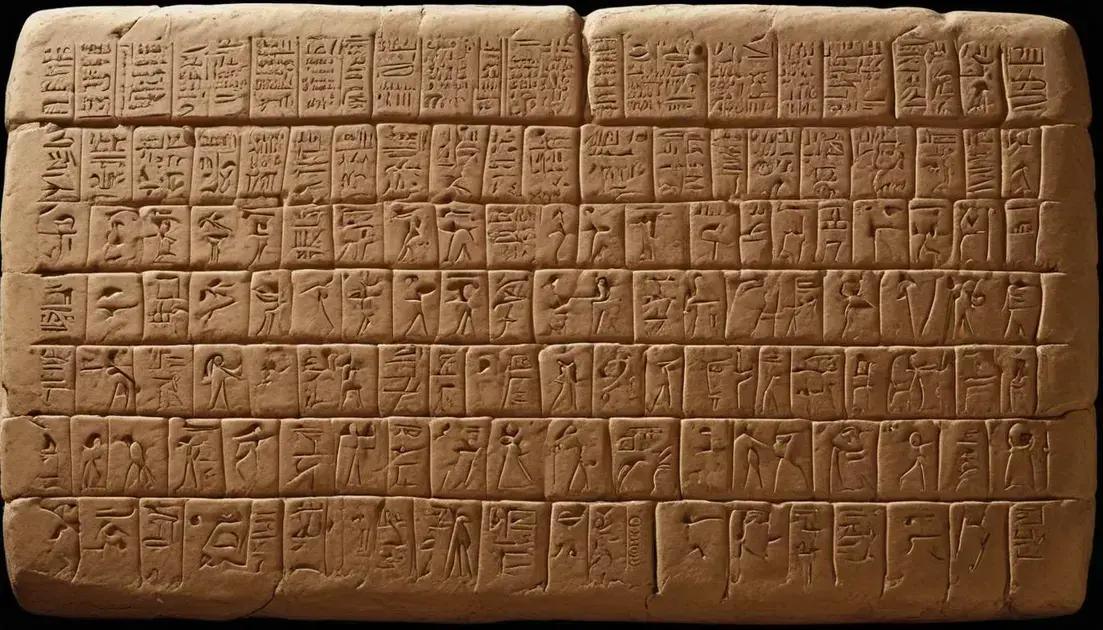
Cuneiform: the world’s first writing system
The Sumerians left a lasting legacy through their advancements in agriculture, the invention of Cuneiform writing, and the establishment of city-states. Their innovations greatly influenced later cultures, enabling effective record-keeping and communication. Sumerian achievements in literature, science, and governance paved the way for future civilizations, showcasing the importance of their contributions to the development of human society.
Ever wondered how the first Cuneiform symbols changed the world? This ancient writing system has so much to reveal about our past!
The Origins of Cuneiform
The origins of Cuneiform date back to ancient Mesopotamia, around 3500 BCE. This early writing system was created by the Sumerians. Initially, it used pictographs which represented objects and ideas.
From Pictographs to Symbols
Over time, these pictographs evolved into simpler symbols. Scribes began to use a stylus on clay tablets. They pressed the stylus to create wedge-shaped marks, which is how Cuneiform got its name.
The Purpose of Cuneiform
Cuneiform was mainly used for record-keeping. It helped manage agricultural goods, track trade, and document laws. This method enabled civilizations to communicate more effectively.
Cuneiform’s Impact on Society
As writing spread, it transformed society. Cuneiform allowed for the preservation of literature, history, and religion. Epic tales like the ‘Epic of Gilgamesh’ were written in Cuneiform.
This writing system laid the foundation for future writing. Today, we see its influence in many modern scripts. Cuneiform didn’t just record information; it shaped cultures and civilizations.
The Evolution of Writing Systems
The evolution of writing systems has been a fascinating journey. Starting from simple marks, humans have developed complex ways to communicate. Around 3000 BCE, the Sumerians in Mesopotamia created the first known writing.
From Pictures to Symbols
Early writing used pictures to represent words. This was called pictographic writing. Pictographs were the first step toward a more advanced system.
The Rise of Phonetic Systems
Later, writing systems became phonetic. This means they represented sounds rather than whole words. The Phoenicians developed one of the first phonetic alphabets around 1200 BCE. This alphabet influenced many modern languages.
Script and Style Variations
As writing spread, different cultures adapted it. Each culture added its own style. For example, Egyptian hieroglyphs used symbols for sounds and meanings. In contrast, Chinese characters represent ideas and concepts.
The Impact on Communication
Writing systems have changed how we share ideas. They allow for the preservation of history, laws, and stories. This ability to record information led to advanced civilizations.
Today, writing continues to evolve. Digital communication has introduced new forms of writing. Emojis and text messages are examples of this change, showing how flexible writing can be.
Influence on Later Cultures
The influence of Cuneiform on later cultures is significant. As one of the first writing systems, it shaped how people communicated. Ancient civilizations learned from Sumerian writing methods.
Adoption by Neighboring Cultures
Many nearby civilizations adopted Cuneiform. The Akkadians, Babylonians, and Assyrians used it for their records. They modified it to suit their languages, which shows its flexibility.
Cuneiform’s Role in Trade
Cuneiform was essential for trade. Merchants kept records of transactions using this system. This helped enhance commerce and set standards for business practices.
Impact on Literature and Politics
Writers recorded stories, laws, and poems in Cuneiform. The famous ‘Epic of Gilgamesh’ is one example. This literature influenced how later cultures viewed storytelling and heroism.
Preserving Knowledge Through Time
Cuneiform tablets have survived for thousands of years. They provide a window into ancient life. Because of this, we understand early governments and social structures better.
The legacy of Cuneiform extends to modern writing. Many alphabets today trace back to its concepts. Thus, Cuneiform laid important groundwork for future civilizations.
The Legacy of Sumerians
The legacy of the Sumerians is vast and influential. They were among the first to establish a complex society in ancient Mesopotamia. Their innovations paved the way for future civilizations.
Advancements in Agriculture
The Sumerians developed advanced farming techniques. They built irrigation systems that helped crops thrive in dry areas. This agricultural innovation supported growing populations.
Invention of Writing
One of their most significant contributions was the invention of Cuneiform. This writing system enabled record-keeping and communication. It laid the foundation for written language in later cultures.
Complex City-States
Sumerians created city-states like Ur and Eridu. Each city-state had its own government and was dedicated to different gods. This organization helped manage resources and trade.
Cultural Achievements
The Sumerians made great strides in art, science, and literature. They created beautiful sculptures and developed math and astronomy. Their epic tales, like the ‘Epic of Gilgamesh,’ still resonate today.
Their religious beliefs and practices influenced later cultures as well. The Sumerians established temples and rituals that shaped worship in Mesopotamia.
The legacy of the Sumerians continues to impact our world. Their innovations in writing, agriculture, and city planning remain foundational in human history.
Conclusion
In conclusion, the legacy of the Sumerians is still felt today. Their inventions, like Cuneiform and advanced agriculture, changed the course of history. These early innovations shaped how societies developed and communicated.
The Sumerians set the stage for future civilizations. Their advancements in writing, governance, and culture laid important foundations. By studying this fascinating history, we gain insight into the complexities of early human life.
As we reflect on their contributions, we recognize how the past informs our present. Understanding the Sumerians helps us appreciate the value of innovation and the power of written communication. Their story is an essential part of our shared heritage.