Big Bang: The Birth of the Universe in an Explosion
The Big Bang Theory explains how the universe began approximately 13.8 billion years ago from a hot, dense point and has been expanding ever since. Key evidence supporting this theory includes cosmic microwave background radiation, the abundance of light elements, and observations of redshift, which shows that galaxies are moving away from us. Understanding the Big Bang not only informs us about the universe’s origins but also influences future research on dark matter and energy, technological advancements, and exploring other planets for potential life.
The Big Bang theory is a revolutionary concept in cosmology that unveils the origins of our universe. Have you ever wondered how everything started?
Understanding the Big Bang Theory
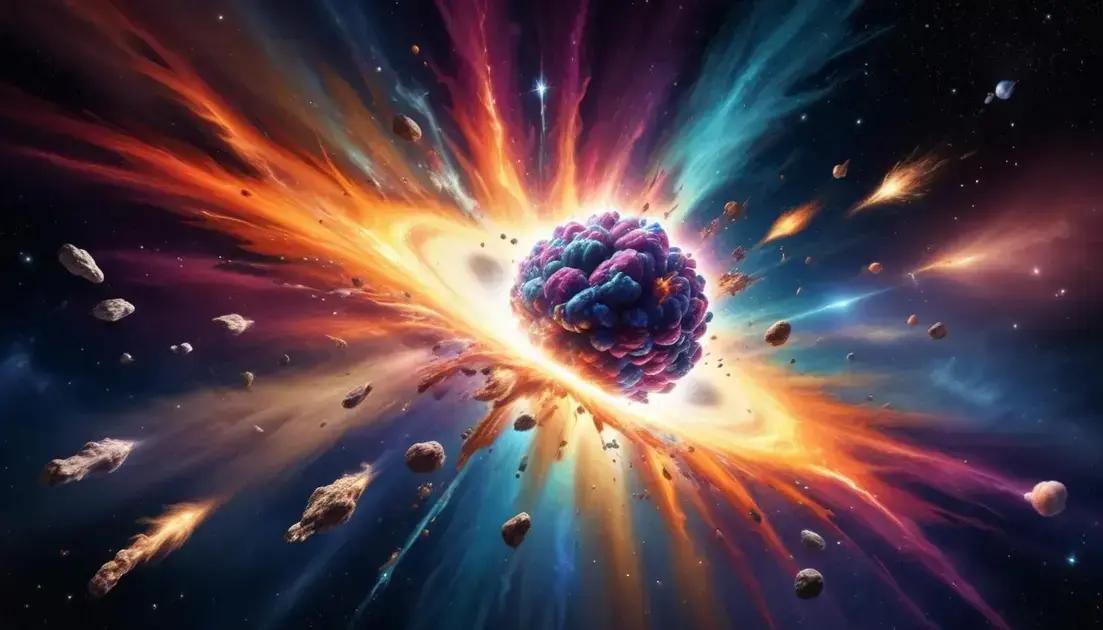
The Big Bang Theory is a scientific explanation of how our universe began. It suggests that around 13.8 billion years ago, everything was concentrated in a tiny point. Suddenly, this point exploded, creating space, time, and all the matter we see today.
Key Concepts of the Big Bang
One key idea is that the universe is expanding. This means it keeps getting bigger since its creation. When we look at distant galaxies, we see them moving away from us. This supports the Big Bang Theory.
The Initial Singularity
The term “singularity” is used to describe that tiny point where all the energy and matter were squeezed. Scientists believe this singularity had extreme heat and density. It wasn’t just a big explosion. It was the start of everything!
Evidence Supporting the Theory
There are strong pieces of evidence that back up this theory. One is cosmic microwave background radiation. This is a faint glow left over from the explosion. It fills the entire universe and supports the idea of a hot beginning.
Another piece of evidence is the abundance of light elements like hydrogen and helium. Scientists have found that they make up most of the universe, just like the Big Bang predicts.
Understanding Cosmic Redshift
The concept of cosmic redshift also ties into the Big Bang Theory. As galaxies move away, their light stretches, making it appear redder. This is similar to a train whistle getting lower as it moves away.
The Big Bang Theory opens our eyes to the vastness of the universe. It invites us to explore where we all came from and how everything fits together. Isn’t it exciting to think that we can understand our universe’s beginnings?
Key Evidence Supporting the Big Bang
When we talk about the Big Bang, there’s a lot of evidence that supports this amazing idea. One key piece is the cosmic microwave background radiation. This faint glow fills the universe and is like a leftover heat from the explosion.
What is Cosmic Microwave Background Radiation?
This radiation is everywhere and comes from all directions. Scientists discovered it in 1965, and it matched what the Big Bang Theory predicted. It’s proof that the universe had a hot start.
Abundance of Light Elements
Another strong piece of evidence is the amount of light elements, like hydrogen and helium. According to the Big Bang Theory, these elements should be abundant. And guess what? Scientists have found they make up about 75% of the universe!
Redshift Observations
We also observe what’s called redshift. This explains how objects in space are moving away. When scientists look at the light from distant galaxies, they see it stretching into longer wavelengths. This shows the universe is expanding.
The Formation of Galaxies
The way galaxies form also supports the Big Bang. Scientists believe they started as tiny clumps of matter that attracted gas and dust over billions of years. This aligns with the idea of an expanding universe.
Each piece of evidence adds weight to the Big Bang Theory. Together, they help us understand our universe’s origins and how it continues to grow and change.
The Impact of Big Bang on Modern Cosmology
The Big Bang has greatly influenced modern cosmology. It changed how we view the universe and our place in it. Before the Big Bang Theory, many believed the universe was static. But then, new ideas emerged!
A New Understanding of the Universe
With the Big Bang, we learned that the universe is ever-changing. It began as a hot, dense point and has been expanding ever since. This concept allows scientists to study the universe’s evolution over time.
Framework for Cosmological Studies
The Big Bang Theory provides a crucial framework for cosmologists. They use this idea to explore how galaxies formed and how stars evolve. With this knowledge, we can better understand the life cycle of celestial objects.
Explaining Background Radiation
This theory also helps explain cosmic microwave background radiation. This radiation is the afterglow of the Big Bang. It is essential for understanding the universe’s early moments and how it expanded.
Influence on Scientific Research
Many scientific fields have been influenced by the Big Bang Theory. It guides research in physics, astronomy, and even philosophy. It raises questions about existence and the ultimate fate of the universe.
Due to its impact, the Big Bang Theory has shaped the way we explore space and our understanding of the cosmos. It encourages curiosity about the origins of everything around us.
Theories of Pre-Big Bang
Before the Big Bang, scientists proposed various theories to explain what existed. These ideas are fascinating and help us understand our universe better. One popular theory is the idea of the universe being eternal.
The Eternal Universe Theory
This theory suggests that the universe has no beginning or end. It has always existed, and it goes through endless cycles of expansion and contraction. This means the universe could keep changing forever.
Inflation Theory
The inflation theory is another interesting pre-Big Bang idea. It proposes a rapid expansion of the universe right after the Big Bang. This expansion is thought to have happened in a tiny fraction of a second, leading to the large universe we see now.
The String Theory
String theory takes a different approach. It suggests that everything is made of tiny, vibrating strings. These strings can create all the particles in the universe. Some versions of this theory hint at multiple universes existing before our own.
Quantum Gravity
Quantum gravity explores how gravity works on a very small scale. This theory looks at how space and time behave at the quantum level. Some scientists believe this understanding could reveal more about the universe before the Big Bang.
Each of these theories tries to answer questions about our universe’s beginnings. They inspire curiosity about what came before and how everything started. Understanding these ideas enriches our view of the cosmos.
Future Implications of Big Bang Research
Research on the Big Bang has exciting implications for the future. Understanding how the universe began helps us learn about its fate. This knowledge is crucial for studying cosmic life cycles.
Exploring Dark Matter and Dark Energy
Big Bang research also leads us to dark matter and dark energy. These mysterious components make up most of the universe. Understanding them could unlock secrets about the universe’s expansion and structure.
Advancements in Technology
Studying the Big Bang has spurred technological advancements. Scientists use powerful telescopes to observe distant galaxies. These tools improve our understanding of the universe and contribute to other fields, like medicine.
Trip to Other Planets
The Big Bang Theory helps shape our exploration of other planets. By understanding how galaxies formed, we can target locations potentially suited for life. This could lead to discovering new worlds!
New Theories and Discoveries
As researchers continue their work, new theories will emerge. Each finding could change how we see the universe. These discoveries will challenge our ideas and inspire future generations of scientists.
Big Bang research is more than just understanding the past. It guides how we think about the universe and our place within it. It’s an adventure that continually unfolds.
Conclusion
In conclusion, exploring the Big Bang and its theories opens up fascinating insights into our universe. Understanding its origins helps us grasp the complex nature of cosmic events. From dark matter to advancements in technology, these discoveries shape how we view our place in the cosmos.
As researchers continue to uncover new findings, the implications for the future are limitless. Each breakthrough encourages curiosity and inspires the next generation of scientists. Ultimately, the journey of learning about the universe is just as important as the answers we seek.