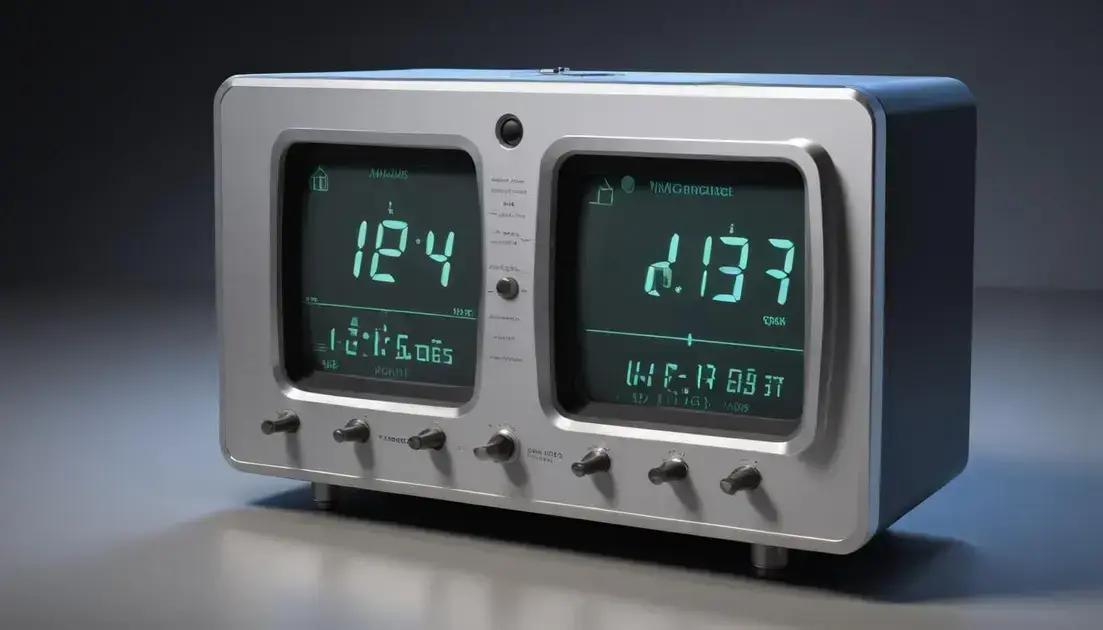
The atomic clock and the invention of perfect time
The atomic clock represents a groundbreaking advancement in timekeeping, utilizing the precise vibrations of atoms to achieve unparalleled accuracy. This innovation significantly impacts various fields, including science, technology, and navigation, enabling accurate measurements and reliable data synchronization. Future developments, like optical lattice clocks, promise even greater precision, enhancing our understanding of time and improving technologies such as GPS and telecommunications for a more efficient world.
Have you ever wondered how we keep time so accurately in our modern world? The invention of the atomic clock has transformed how we think about timekeeping, bringing unprecedented precision and reliability.
Understanding Atomic Clocks
Understanding atomic clocks is key to grasping how we measure time today. These clocks use the vibrations of atoms to keep incredibly accurate time. The most common atom used is cesium. When cesium atoms vibrate, they create a consistent frequency that allows atomic clocks to track time precisely.
What Makes Atomic Clocks Unique?
Atomic clocks are different from traditional clocks. Traditional clocks measure time based on moving parts or mechanical mechanisms. In contrast, atomic clocks rely on the natural rhythms of atoms. This means they can stay accurate for many years without needing adjustments.
How Does an Atomic Clock Work?
An atomic clock works by heating atoms until they vibrate at a specific frequency. These vibrations are counted to measure time. The more consistent the frequency, the more accurate the clock is. This technology plays a crucial role in GPS systems and global communications.
The Importance of Accuracy
Accuracy matters a lot in technology. GPS systems need precise timing to provide accurate location data. If a clock is off by even a minute, it can lead to significant errors in navigation. Atomic clocks help prevent this by ensuring exceptional accuracy.
Thanks to atomic clocks, we can coordinate activities across the globe seamlessly. Whether it’s sending satellites into orbit or keeping your smartphone connected, these clocks make it all possible.
Precision in Timekeeping
Precision in timekeeping is essential in our fast-paced world. With the rise of technology, accurate time measurement has become more important than ever. Atomic clocks lead the way in this area. They offer remarkable accuracy that far exceeds traditional clocks.
Atomic clocks measure time based on the vibrations of atoms, which provides a stable and consistent frequency. This process makes them incredibly reliable. For example, a cesium atomic clock is accurate to within a second over millions of years. That’s a stunning level of precision!
Why Precision Matters
Precision affects many aspects of our lives. In navigation, for instance, GPS systems depend on exact timing. If the clocks are off, then your location could be wrong. This can lead to serious navigation errors.
Science and technology also rely on precision. When conducting experiments, even tiny time discrepancies can alter results. This impacts everything from research studies to satellite launches. A few seconds can make a significant difference.
Advancements in Timekeeping Technology
Advancements in atomic clock technology keep improving their accuracy. New designs use trapped ions or optical lattice techniques. These methods can further enhance the precision of timekeeping systems, making them even more useful for various applications.
With each step forward, our understanding of time deepens. The impact of precise timekeeping is felt in many fields, from telecommunications to space exploration. It helps keep our modern world operating smoothly.
Impact on Science and Technology
The impact on science and technology from atomic clocks is huge. These clocks help researchers get precise measurements for experiments. Precision is critical in scientific fields. Even small errors can lead to big mistakes.
In fields like astronomy, scientists need exact time to track celestial events. Atomic clocks allow them to measure time accurately, which helps in observing phenomena like eclipses and supernovae.
Advancing Technology
Technology is also benefiting from these advancements. GPS technology relies on accurate timekeeping to work properly. If the clocks are off by just a second, users may end up in the wrong place.
Telecommunications benefit greatly as well. Time synchronization ensures that data transfers occur smoothly. This keeps our phones and internet connections working without interruptions.
Influence on Research
Research studies depend on accurate timing for valid results. Many fields, including physics and biology, use atomic clocks to improve various processes. For instance, they help scientists study atomic behaviors, which can lead to breakthroughs in understanding the universe.
With every new development in atomic clock technology, our scientific capabilities expand. As we continue to make advancements in this area, we can expect even more exciting discoveries in the near future.
Future of Time Measurement
The future of time measurement looks bright with new technologies emerging all the time. Atomic clocks are only the beginning. Researchers are always looking for ways to improve accuracy even more. New methods are being studied that might change how we measure time forever.
One exciting area is optical lattice clocks. These clocks use lasers to trap atoms, allowing for even more precise timekeeping. They promise accuracy that can measure time over billions of years without error. That’s a remarkable feat!
The Role of Quantum Technology
Quantum technology plays a big role in the future of time measurement. As we understand quantum mechanics better, we can create even more reliable clocks. This will help in fields like global positioning and telecommunications.
Quantum clocks are already showing great potential. They could lead to advancements that make our everyday technology faster and more efficient. Imagine a world where GPS systems are perfectly accurate and communications are seamless.
Potential Applications
Accurate timekeeping could transform many areas. High-precision clocks might improve data networks, making internet connections more reliable. Industries like finance and transportation could benefit from reliable timing as well.
As technology advances, the possibilities are endless. The future of time measurement holds surprising changes that will improve our daily lives in ways we can’t yet imagine.
Conclusion
In conclusion, the advancements in time measurement technology, especially with atomic clocks, have a significant impact on our world. These innovations are key to ensuring accuracy in science, technology, and daily life. As we look to the future, exciting developments like optical lattice clocks promise even greater precision.
Improved timekeeping affects many fields, from navigation to communication. As we embrace these cutting-edge technologies, we not only enhance our understanding of time but also open doors to new possibilities. Investing in better time measurement tools will make our modern world more efficient and connected.