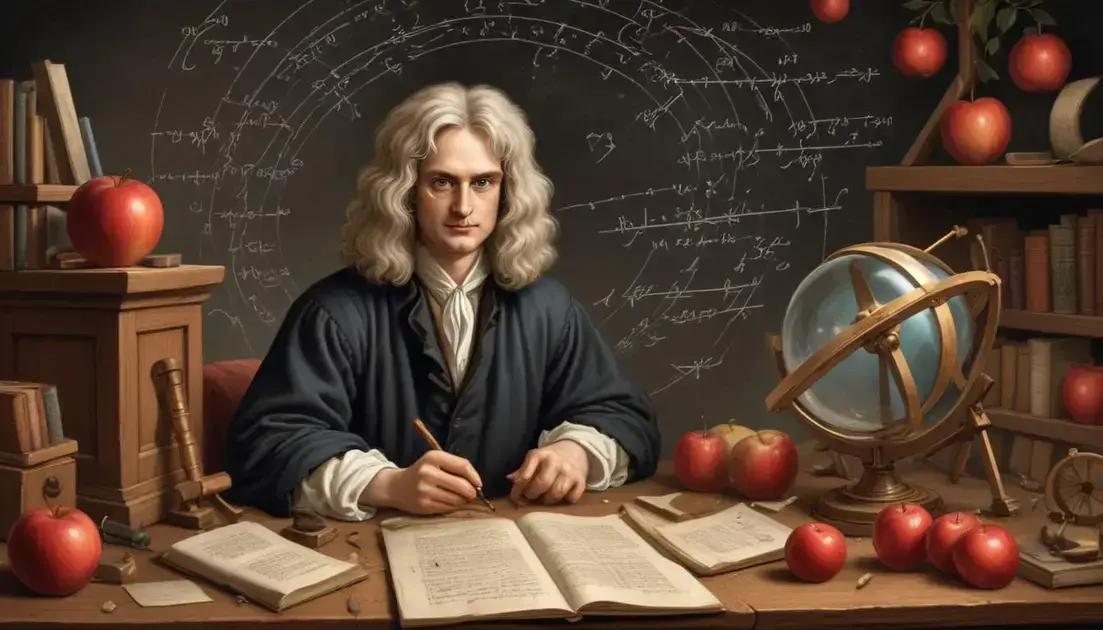
Isaac Newton: the man who explained the universe
Isaac Newton, a pivotal figure in science, introduced foundational concepts including the laws of motion and universal gravitation, which revolutionized physics. His work in mathematics led to the development of calculus, and his studies in optics unveiled the nature of light and color. Newton’s legacy continues to impact various scientific fields, inspiring future generations to explore and understand the universe.
Isaac Newton was more than just a mathematician; he was the key to unlocking the secrets of our universe. Ever wondered how gravity works or why objects move as they do? Let’s dive into his remarkable journey!
Newton’s Early Life
Isaac Newton was born on January 4, 1643, in Woolsthorpe, England. His early life was not easy. He was born just a few months after his father died. His mother remarried when he was three. She left him with his grandmother. This made young Isaac very independent.
As a boy, Isaac loved to explore. He enjoyed making things and experimenting. For example, he made a small model of a windmill. He was curious about how things worked. This curiosity led him to school, where he did very well.
At school, Isaac did not like the strict rules. He often felt bored with his lessons. Instead of just following what teachers said, he wanted to discover things for himself. This desire to learn more about the world around him stayed with him.
When he was a teenager, Isaac went to Trinity College, Cambridge. There, he studied math and science. He learned from famous thinkers like Descartes and Galileo. These ideas sparked his imagination and changed how he thought about the world.
Even as a young man, Isaac showed signs of great talent. His teachers noticed his keen mind and creativity. This early passion helped him later when he made discoveries that changed science forever.
The Laws of Motion
Isaac Newton was famous for his Three Laws of Motion. These laws explain how objects move and interact. They changed the way we understand physics and the universe.
The first law is often called the law of inertia. It says that an object will stay at rest or keep moving unless a force acts on it. For example, if you roll a ball on the ground, it keeps rolling until friction or another force stops it.
The second law describes how forces affect motion. It tells us that the force on an object equals its mass times its acceleration (F = ma). So, if you push a heavy object, it won’t move as fast as a lighter one. This is why it’s harder to move a car than a bicycle.
The third law is all about action and reaction. It states that for every action, there’s an equal and opposite reaction. If you jump off a small boat, you push the boat backward as you move forward. This law helps us understand things like rocket propulsion too.
These laws don’t just apply to simple situations. They’re used in everything from designing cars to sending rockets into space. Newton’s laws are key to many areas of science and engineering!
Universal Gravitation
Universal Gravitation is one of Isaac Newton’s most important ideas. This law explains how every object in the universe attracts every other object. The force of this attraction is called gravity.
The strength of gravity depends on two things: the mass of the objects and the distance between them. Bigger objects, like Earth, have a stronger pull. If you’re closer to a large object, like a planet, you feel more of its gravitational pull.
For example, when you jump, gravity pulls you back to the ground. This is why you can’t just float away! It also keeps the moon in orbit around Earth and the planets around the sun.
Newton’s law of universal gravitation helped us understand how the solar system works. It showed that gravity doesn’t just affect objects on Earth but also those in space. This discovery changed how we see the universe.
Universal gravitation is not just a theory; it is proven by many observations. Scientists can use this law to predict how objects move in space. It helps us understand everything from falling apples to orbiting satellites.
Impact on Modern Science
The impact of Isaac Newton’s work on modern science is truly enormous. His ideas laid the grounding for many scientific fields we study today. From physics to astronomy, Newton’s principles still guide research.
His laws of motion and universal gravitation helped people understand how forces work. This knowledge allows scientists to predict the movements of planets and objects on Earth. It brought clarity to how everything interacts in the universe.
Newton’s approach to experimentation also changed science. He believed in testing ideas with experiments, not just thinking about them. This helped scientists gather real proof of their theories. It set the standard for modern scientific methods.
Because of Newton, we can feel confident in our understanding of the physical world. His work also inspired many later scientists, like Einstein. They built on his findings and expanded our grasp of even deeper truths.
Today, engineers, astronomers, and physicists use Newton’s laws every day. Whether launching satellites or calculating speeds, his legacy is felt in every scientific discipline. Newton indeed made science more complete and understandable!
Legacy of Isaac Newton
The legacy of Isaac Newton is immense and still influences us today. His discoveries changed our understanding of science and the universe. Many view him as one of the greatest scientists in history.
Newton’s laws of motion and gravitation are fundamental. They are taught in schools around the world. These principles help us understand how objects move and interact, whether on Earth or in space.
Beyond physics, Newton contributed to mathematics, creating calculus. This branch of math helps scientists solve complex problems. His work laid the foundation for future mathematicians and scientists.
Newton also made advancements in optics. He studied light and color, discovering that white light is made of many colors. His experiments paved the way for modern physics and technology in optics.
Newton’s dedication to science inspired many generations. He showed how curiosity and hard work can lead to great discoveries. People continue to celebrate his life and work in books, movies, and educational material.
His influence is seen in modern technology, engineering, and space exploration. Newton’s ideas help engineers design safer vehicles and craft reliable satellites.
Conclusion
In conclusion, Isaac Newton’s contributions to science have shaped our understanding of the world around us. His laws of motion and universal gravitation remain vital in physics today. Newton’s work in mathematics and optics also opened doors for further discoveries.
His legacy inspires scientists and curious minds everywhere. By exploring his ideas, we continue to uncover more about the universe. Newton showed us the power of questions and hands-on learning. His discoveries remind us that curiosity can lead to incredible advancements.
As we look to the future, we should appreciate how Newton’s insights influence our lives every day, from technology to space exploration. Understanding his work helps us see the world in new ways and inspires future generations of scientists.