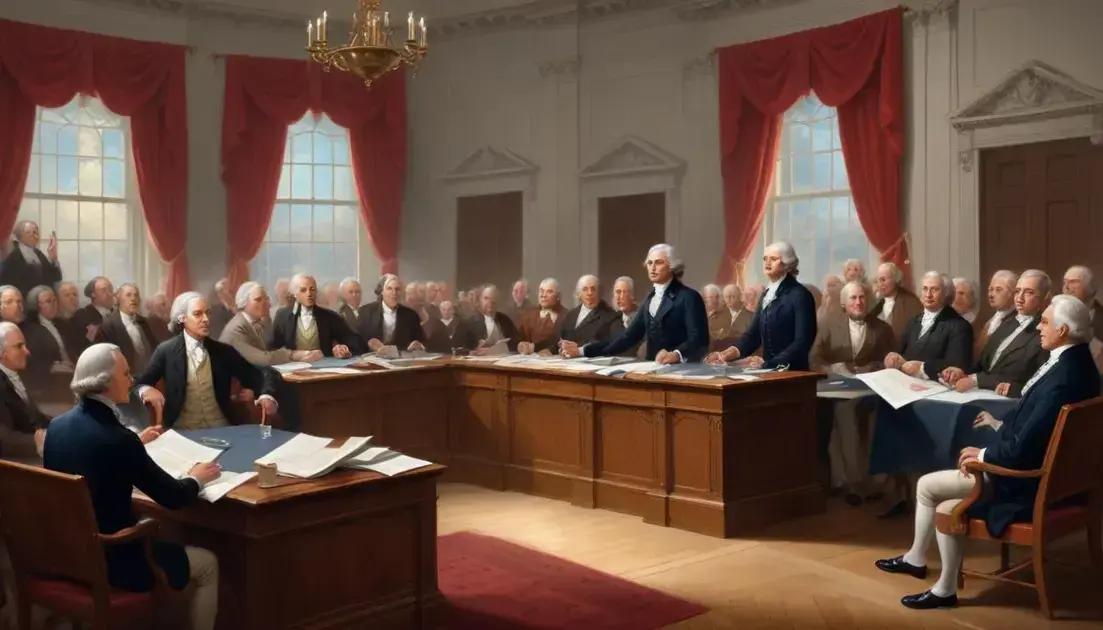
Constitutional Convention: the creation of the U.S. government
The Constitutional Convention was a crucial event in 1787 where key figures like George Washington and James Madison gathered to discuss and create a new U.S. Constitution. They sought to address the weaknesses of the Articles of Confederation through debates and compromises, resulting in a balanced government structure with mechanisms like the Great Compromise and the Three-Fifths Compromise. The successful ratification required the addition of the Bill of Rights, ensuring protection for individual freedoms. This historical moment laid the foundation for modern American democracy and governance.
Ever wondered how the U.S. Government came into existence? Dive into the intriguing story of the Constitutional Convention that shaped our nation.
Introduction to the Constitutional Convention
The Constitutional Convention was a key moment in U.S. history. This event took place in 1787 in Philadelphia. Delegates from all the states gathered to discuss and fix the problems in the Articles of Confederation.
Many leaders, like George Washington and Benjamin Franklin, played important roles. They knew that a stronger government was needed. The Articles of Confederation created a weak national government, which led to many issues.
During the convention, they debated various ideas. Some wanted a strong central government, while others feared too much power. This debate led to many compromises that shaped our Constitution.
One major outcome was the Great Compromise. This created a bicameral legislature, meaning two houses of Congress: the House of Representatives and the Senate. This balance helped to satisfy both larger and smaller states.
Additionally, the Three-Fifths Compromise was made regarding how to count slaves for representation. This compromise showed how complex the discussions were. Ultimately, after much debate, the Constitution was born. It paved the way for a new government structure.
Today, the Constitutional Convention is seen as a vital step in American democracy. It helped establish the principles we still value. The framers aimed to create a government that protected rights and promoted justice.
Why It Matters
Understanding the Constitutional Convention helps us see how far we have come. It was not just about rules; it was about creating a nation. The issues discussed then still echo today in our politics and laws.
Key Figures and Their Contributions
Many important people shaped the Constitutional Convention. These key figures came with different backgrounds and ideas. Their contributions helped create the U.S. Constitution.
George Washington was the leader of the convention. He was respected by all. His strong presence helped keep the discussions focused. Washington believed a strong national government was vital.
James Madison is often called the “Father of the Constitution.” He had a big role in writing and promoting it. Madison’s notes during the convention provide valuable insights into the debates.
Benjamin Franklin was another significant figure. As an older statesman, he used his wisdom to guide younger delegates. Franklin was known for fostering compromise and unity.
Alexander Hamilton pushed for a strong federal government. He argued that a central authority could better manage the economy and defend the nation. Hamilton’s ideas were vital in shaping the Constitution.
Roger Sherman created the Great Compromise. This plan balanced representation for both large and small states. His work helped keep the convention going when tensions were high.
Each of these figures had unique visions. They didn’t always agree, but their discussions led to crucial compromises. Understanding their roles helps us appreciate the Constitution’s creation.
The Articles of Confederation
The Articles of Confederation were the first written constitution of the United States. They were ratified in 1781, during the Revolutionary War. However, they had many problems that led to their downfall.
Under the Articles, states held most of the power. This meant the national government was weak and had limited abilities. It could not collect taxes or regulate trade. This made it hard to pay debts and support a military.
Each state acted like its own country. They could make their own laws and currency. This caused confusion and disagreements. For example, states often taxed each other’s goods, which hurt trade.
Moreover, there was no executive branch to enforce laws. This meant there was no one to ensure that states followed agreements. This lack of control led to problems like Shays’ Rebellion.
Shays’ Rebellion was a protest by farmers in 1786. They were upset about high taxes and debt. The rebellion highlighted the weaknesses of the Articles. It showed that the national government could not keep order.
In 1787, leaders called for a convention to address these issues. They realized that a stronger central government was needed. This led to the creation of the U.S. Constitution, which replaced the Articles of Confederation.
Debates and Compromises
During the Constitutional Convention, debates and compromises were essential for progress. Delegates had strong ideas about how the new government should work. Differences often led to heated discussions.
One major debate centered around representation. Large states wanted representation based on population, while small states wanted equal votes. This disagreement could have derailed the talks. However, they reached the Great Compromise to find balance.
The Great Compromise created a bicameral legislature. This means there are two houses: the Senate and the House of Representatives. In the Senate, each state gets two votes, while representation in the House is based on population.
Another critical issue was how to count enslaved people for representation. Southern states wanted to count them fully, while northern states did not want to count them at all. They agreed on the Three-Fifths Compromise, which counted each enslaved person as three-fifths of a person.
Debates also included the powers of the federal government. Some delegates feared a strong central authority would take away states’ rights. Others believed a strong government was necessary for unity. Finding common ground was tough but crucial.
These compromises allowed the convention to move forward. They showed how diverse views can lead to practical solutions. Understanding these debates helps us appreciate the Constitution today.
Ratification and Aftermath
After the Constitutional Convention, the next step was ratification. This meant that states needed to approve the new Constitution. Ratification was not easy. There were many debates and disagreements.
Some people supported the Constitution. They called themselves Federalists. They believed a strong central government was necessary for the country to grow and thrive. Key Federalists included Alexander Hamilton and James Madison.
Others were against the Constitution. These Anti-Federalists worried that a strong government might take away individual rights. They argued that without a Bill of Rights, people’s freedoms would be at risk.
The ratification process began in 1788. Each state held conventions to discuss and vote on the Constitution. The ninth state, New Hampshire, ratified it in June 1788, making the Constitution official.
However, several states demanded a Bill of Rights to protect citizens. To gain support from these states, Federalists promised to add it once the Constitution was in place. This promise helped secure ratification in key states like Virginia and New York.
In 1791, the first ten amendments were added as the Bill of Rights. These amendments guaranteed essential liberties, such as freedom of speech and religion. The ratification and addition of the Bill of Rights were significant moments in U.S. history.
The aftermath of ratification set the stage for the new government. It created a framework that still guides the nation today. The debates and compromises shaped American democracy and established the principles of rights and governance.
Conclusion
In conclusion, the Constitutional Convention was a pivotal moment in American history. It brought together key figures who debated and made important compromises. These discussions led to the creation of the U.S. Constitution, establishing a strong national government.
The challenges of the Articles of Confederation highlighted the need for change. Through ratification, the new Constitution secured support, even amidst disagreements. The addition of the Bill of Rights ensured individual freedoms were protected.
Today, the principles established during the convention continue to guide our democracy. Understanding this history helps us appreciate the rights we have and the government we live under. The legacy of the Constitutional Convention remains vital to American identity.