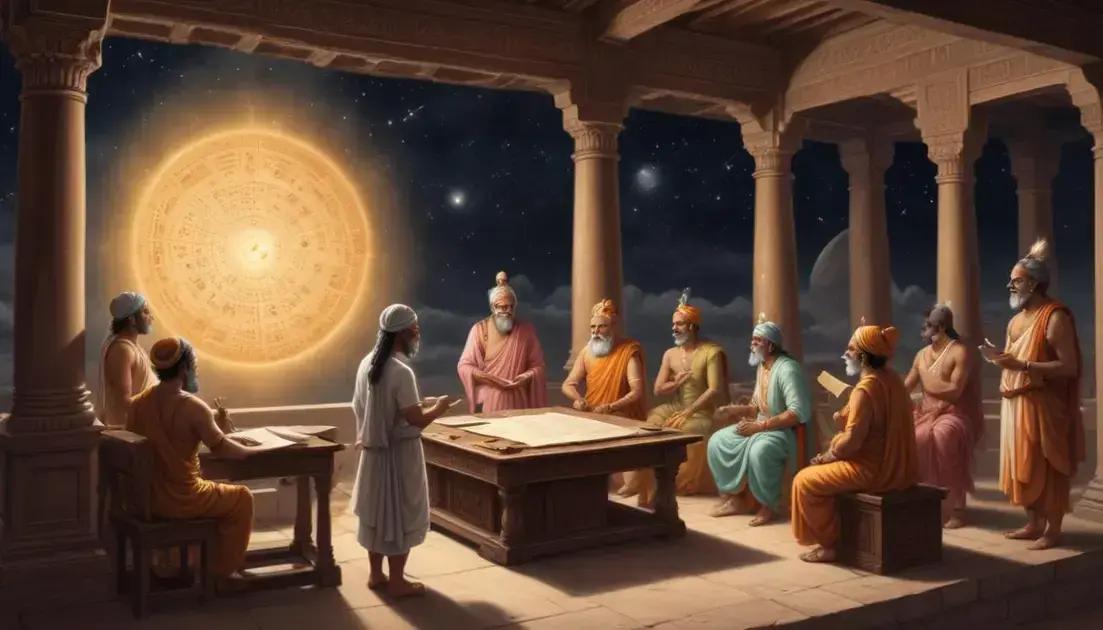
Gupta Empire: India’s golden age of science
The Gupta Empire, known as a golden age for India, made significant contributions to mathematics, astronomy, and medicine. This era introduced key concepts like zero and the decimal system, greatly influencing modern mathematics. Notable scholars improved our understanding of celestial movements and made strides in medical texts, which laid the groundwork for Ayurvedic practices. The cultural flourishing during this period also led to advancements in art, literature, and music, creating a rich legacy that continues to impact the world today.
Welcome to the fascinating world of the Gupta Empire, a golden age of science and culture that shaped ancient India. Have you ever wondered how this era influenced modern advancements? Let’s dive in!
The Rise of the Gupta Empire
The rise of the Gupta Empire marked a significant time in ancient India. This period lasted from around 320 to 550 CE and is often celebrated as a golden age of cultural and scientific achievements.
The empire began with Chandragupta I, who unified several small kingdoms. His strong leadership helped establish a powerful state in North India. He expanded the empire through smart alliances and military strength, creating a stable environment for growth.
Chandragupta’s son, Samudragupta, took the empire further. Known as the “Napoleon of India,” he was an exceptional warrior and ruler. He expanded his father’s realm through many successful battles. Under his reign, the Gupta Empire became the most influential power in India.
The Gupta Empire is also important for its contributions to art and culture. During this time, literature, music, and theater flourished. Notable poets and scholars emerged, mentoring future generations.
In addition to culture, the empire excelled in mathematics. Notably, this era saw the introduction of the concept of zero and the decimal system. These advancements laid the foundation for modern mathematics.
Astronomy also experienced significant growth during this time. The Gupta scholars made numerous discoveries about celestial bodies and developed accurate calendars. Their work influenced later scientists around the world.
Overall, the rise of the Gupta Empire was not just about military success. It was a period of incredible intellectual and cultural growth that shaped India’s future. This foundation helped pave the way for future advancements and nurtured a rich heritage that continues to influence the world today.
Contributions to Mathematics
During the Gupta Empire, significant advancements in mathematics took place. This period is often called the golden age of math in India. Scholars made remarkable discoveries that changed the way we understand numbers today.
One of the most important inventions was the concept of zero. Before this, people had no way to show nothing in number form. The inclusion of zero was revolutionary and paved the way for advanced calculations.
The decimal system also became popular during this time. This system uses ten digits from 0 to 9. It made counting and calculations easier and is the same system we use today.
Mathematicians like Aryabhata emerged, contributing greatly to the field. He wrote important texts, discussing topics such as algebra and trigonometry. His work laid the foundation for future mathematicians across the globe.
Aryabhata also accurately calculated the value of pi (π). He provided estimates that were very close to the actual value, showcasing the advanced understanding of geometry among Gupta scholars.
In addition to these, the Gupta mathematicians introduced methods of solving quadratic equations. They showed that there are multiple ways to find solutions. This understanding would later influence modern mathematics significantly.
The legacy of Gupta mathematics didn’t stop at their time. Their discoveries spread to different regions, influencing scholars in the Middle East and Europe. This exchange of knowledge is part of what helped mathematics evolve into what we know today.
In summary, the contributions to mathematics during the Gupta Empire were crucial. They shaped fundamental concepts still used around the world and inspired countless future mathematicians.
Advancements in Astronomy
The Gupta Empire was a golden age for astronomy in India. Scholars made key advancements that shaped our understanding of the universe. They came up with many concepts still used in astronomy today.
One of the most notable astronomers was Aryabhata. He proposed that the Earth rotates on its axis. This idea was groundbreaking and changed how people viewed the cosmos.
Aryabhata also calculated the circumference of the Earth accurately. His measurement was very close to modern figures. This showed how advanced Gupta scholars were in their calculations.
The Gupta astronomers created detailed star catalogs. They mapped the positions of stars and planets. By observing the night sky, they learned about celestial movements and cycles.
They also developed the concept of eclipses. They understood how and why eclipses occur. This knowledge helped predict when these events would take place. Their work in this area was vital for future astronomers.
In addition, fellow astronomers created tools like the armillary sphere. This device helped visualize the movements of celestial bodies. It was a crucial instrument for studying astronomy at that time.
The Gupta Empire’s advancements didn’t just stay in India. Their observations and texts traveled far and wide. They influenced later generations of astronomers in places like the Middle East and Europe.
Overall, the Gupta Empire made significant contributions to astronomy. Their work laid the groundwork for future discoveries and helped deepen our understanding of the universe.
Cultural Flourishing
The Gupta Empire was a vibrant time for cultural flourishing. This period saw great achievements in art, literature, and music. Many talented individuals emerged, making lasting impacts on Indian culture.
Literature thrived under Gupta rule. Writers like Kalidasa produced famous plays and poems. His work is still celebrated today for its beauty and depth. Kalidasa’s play, Shakuntala, is one of the most loved pieces from this era.
In addition to literature, art experienced a golden age. Sculptors created stunning works depicting gods and goddesses. The art from this time is known for its intricate details and lifelike expressions. Temples built during the Gupta period often feature these remarkable sculptures.
Music also flourished, with new styles and instruments emerging. Musicians developed various forms of classical music. Their contributions laid the foundation for many styles of Indian music we hear today.
Dance forms were another area of growth. Religious ceremonies often featured dance, blending storytelling with music. This helped express cultural beliefs and traditions through artistic performances.
The spread of religion during the Gupta Empire also enhanced cultural life. Hinduism and Buddhism thrived, leading to the creation of many beautiful temples and monasteries. These became important centers for art and learning.
The Gupta Empire’s support for education was significant. Universities like Nalanda became renowned. Students came from far and wide to study subjects like astronomy, mathematics, and philosophy. This exchange of ideas enriched the cultural landscape of India.
Overall, the cultural flourishing during the Gupta Empire created a rich legacy. This legacy still influences art, literature, and music in modern India.
Impact on Modern Science
The Gupta Empire had a lasting impact on modern science. Many of the discoveries made during this time laid the groundwork for future advancements. Scholars during the Gupta period made notable contributions in various scientific fields.
In mathematics, the introduction of zero and the decimal system changed how we perform calculations. These concepts are essential in arithmetic and are still used today around the world.
In astronomy, Gupta scholars developed methods for observing celestial bodies. Their understanding of planetary movements and eclipses helped shape modern astronomy. Many principles they established still guide astronomers today.
The Gupta period also influenced the field of medicine. Doctors like Charaka wrote important texts on medicine and surgery. Their work laid the foundation for Ayurvedic medicine, a system still practiced in India.
In addition, Gupta scientists made strides in chemistry and metallurgy. They developed techniques to create high-quality steel, which was advanced for that time. Their methods contributed to the development of metallurgy techniques used in many industries today.
Furthermore, the scientific methods used by Gupta scholars emphasized observation and experimentation. These methods form the basis for the scientific approach we use in modern science.
The sharing of knowledge during the Gupta Empire also paved the way for future discoveries. Scholars traveled and exchanged ideas, ensuring that what they learned continued to spread. This exchange fueled progress in various scientific fields.
Overall, the impact of the Gupta Empire on modern science is profound. Their contributions are evident in many areas of science, shaping the world as we know it.
Conclusion
In conclusion, the Gupta Empire played a vital role in shaping various fields of knowledge, including mathematics, astronomy, and medicine. Their groundbreaking discoveries laid the groundwork for modern science as we know it today. The introduction of concepts like zero and the decimal system changed mathematics forever.
The advancements in astronomy helped our understanding of celestial events, while contributions in medicine continue to influence health practices. The emphasis on experimentation and observation set the stage for future scientific methods.
Overall, the cultural and scientific achievements during the Gupta Empire not only enriched their society but also left a legacy that still impacts the world. Exploring this era shows us how knowledge can evolve and continue to inspire generations.