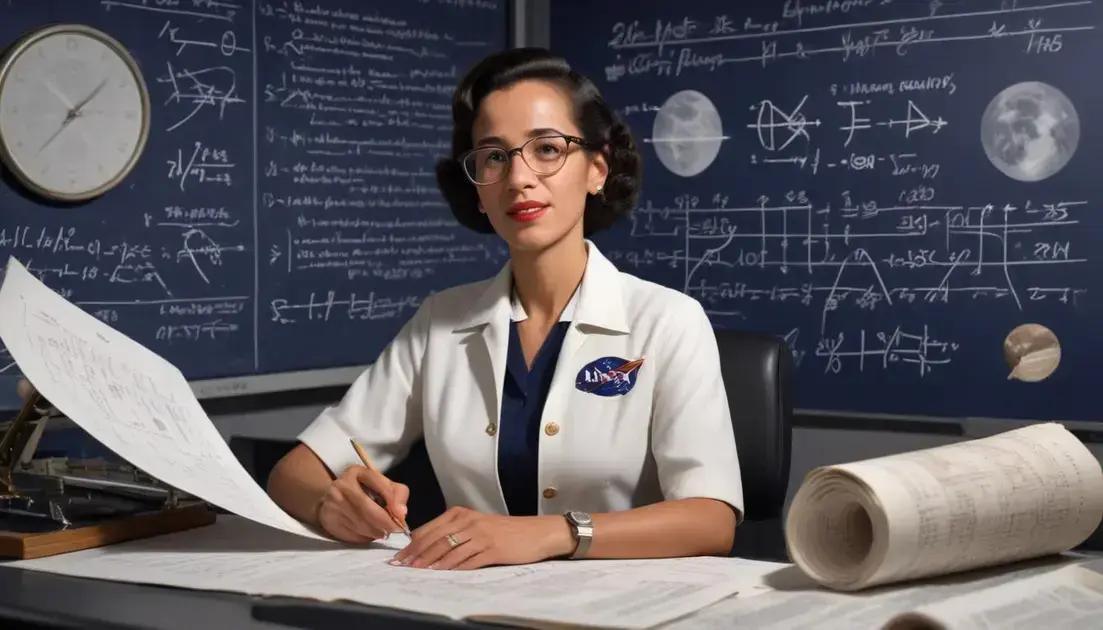
Katherine Johnson: the mathematician who sent us to the moon
Katherine Johnson was a groundbreaking mathematician whose work at NASA was vital in the success of the Apollo missions. Known for her accurate calculations that enabled space travel, she overcame racial and gender barriers in the STEM field. Her legacy inspires generations, particularly young women and minorities, to pursue careers in science and technology, highlighting the importance of diversity in innovation.
Katherine Johnson broke barriers with her remarkable calculations at NASA, showcasing her genius in a world where few got the chance. What drove her to reach for the stars?
The Early Life of Katherine Johnson
Katherine Johnson was born on August 26, 1918, in White Sulphur Springs, West Virginia. As a child, she loved math. She would count everything around her. By the age of just five, she was already doing high school-level math. That’s pretty impressive!
Her family saw her talent early on. They supported her education and encouraged her studies. Katherine attended a special high school for talented students. Here, she excelled in math and science.
After finishing high school, she enrolled at West Virginia University. She was one of the first African American women to attend the school. This was a big step during a time of segregation. Katherine faced many challenges but never backed down.
She graduated summa cum laude in 1937 with degrees in mathematics and French. How amazing is that? This hard work set the stage for her future. It showed that she wouldn’t let anything hold her back.
After college, she started her career as a teacher. However, her passion for math called her to NASA. Little did she know, she would soon play a key role in the race to the moon.
Overcoming Racial Barriers
Katherine Johnson faced many racial barriers during her career. She worked at a time when segregation was common. Many doors were closed to African Americans, especially women. But Katherine was determined to break through.
When she joined NASA, she was one of the few Black women there. This was not easy. She dealt with unfair treatment and doubt from others. Still, she never let that stop her. Her talent and hard work stood out.
At NASA, Katherine made important calculations that helped astronauts. She worked on the first American orbit flight in 1962. Her math skills were crucial to the success of missions.
Katherine’s achievements helped show that people from all backgrounds can succeed in STEM fields. She opened doors for many others. Her story inspires countless individuals today.
Despite the challenges, Katherine Johnson proved that race doesn’t define talent. Her life reminds us to break down barriers and be resilient.
Her Role in NASA
Katherine Johnson’s role at NASA was crucial to the success of many missions. She started working there in 1953 as a computer. It was a challenging time, but she quickly showed her talent.
Her main job was to calculate the paths for space flights. Katherine worked on the calculations for the first American to orbit the Earth, John Glenn, in 1962. He trusted her numbers. He even asked NASA to double-check them before the flight.
In addition to orbits, Katherine also helped with the Apollo missions. She calculated the trajectory for Apollo 11, which landed the first humans on the moon in 1969. Her math saved lives and made history.
Katherine’s work was groundbreaking. She showed how important it was to have diverse voices in STEM. By being one of the first women and African Americans at NASA, she opened doors for many others.
Today, Katherine Johnson is remembered as a pioneer in space exploration. Her legacy continues to inspire future generations to reach for the stars.
The Apollo Missions
The Apollo missions were a series of space flights aimed at landing humans on the moon. Katherine Johnson played a key role in these missions. Her calculations ensured that astronauts could travel safely to their destination and return home.
Apollo 11 was the most famous mission. It launched in 1969 and landed the first humans on the moon. Neil Armstrong and Buzz Aldrin stepped onto the lunar surface. Katherine’s math helped plan their flight path, making their journey possible.
She worked on trajectory analysis, which calculated the best route to the moon. This involved complex equations, but she made it look easy. Her work was critical to the success of Apollo 11.
After Apollo 11, Katherine continued to contribute to later missions. Each mission built on the success of the previous ones, and Katherine’s input was invaluable. She showed that math could truly push the boundaries of space exploration.
The Apollo missions marked a giant leap for mankind, and Katherine Johnson was right there, helping to make history.
Legacy of Katherine Johnson
Katherine Johnson’s legacy shines brightly in the world of science and mathematics. She broke barriers for women and African Americans in STEM fields. Her story shows that anyone can achieve great things with talent and determination.
Her work at NASA during the Apollo missions changed history. Katherine showed how important it is to include diverse voices in problem-solving. Her calculations made space travel safer and more successful.
After her retirement, Katherine received numerous awards for her contributions. She was honored with the Presidential Medal of Freedom in 2015. This award recognizes her impact on space exploration and civil rights.
Katherine’s story has inspired many young people, especially girls and minorities. She encourages them to pursue careers in science, technology, engineering, and math. Schools now celebrate her achievements as a role model.
Today, her legacy continues to influence future generations. Katherine Johnson showed us that with hard work and perseverance, we can reach for the stars.
Conclusion
In conclusion, Katherine Johnson’s life is a powerful example of breaking barriers in science and mathematics. Her remarkable work at NASA not only helped put a man on the moon but also paved the way for future generations. Katherine showed us that courage and talent can overcome any challenge.
Her legacy continues to inspire young people, especially girls and minorities, to pursue careers in STEM. By honoring her contributions, we remind ourselves of the importance of diversity in innovation. As we look to the future, let’s carry forward her spirit of perseverance and dedication. Katherine Johnson proved that when we reach for the stars, anything is possible.
Tags: