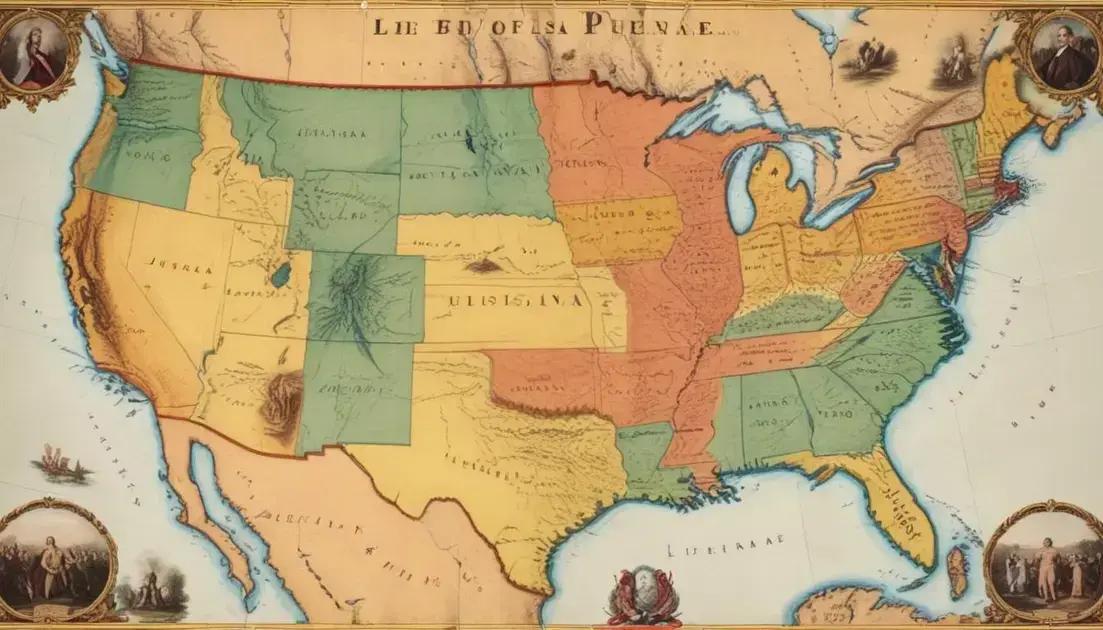
Louisiana Purchase: the land deal that doubled America
The Louisiana Purchase was a pivotal event in U.S. history, doubling the nation’s size and opening new territories for settlement and exploration. Signed in 1803, this land deal with France not only expanded American geography but also had significant consequences for Native Americans, as it led to widespread displacement and conflict. Today, the legacy of the Louisiana Purchase continues to influence the United States, shaping discussions about land use, governance, and cultural history.
Louisiana Purchase was a pivotal moment in U.S. history that changed the landscape of America forever. How did this $15 million deal redefine a nation?<\/p>
Overview of the Louisiana Purchase
The Louisiana Purchase was a huge land deal made in 1803. The United States bought about 827,000 square miles of land from France. This area stretched from the Mississippi River to the Rocky Mountains, more than doubling the size of the country.
At the time, President Thomas Jefferson saw this as a way to secure land for future generations. The price? Just $15 million! That’s less than three cents an acre.
Many people worried about how this purchase would change the nation. Some thought it would strengthen the U.S. economy, while others worried it could lead to conflicts with Native Americans.
The land included parts of what are now 15 states, from Louisiana to Montana. This new land opened up opportunities for westward expansion and farming.
Next, let’s dive into the key players involved and the events that led to this groundbreaking transaction.
Key Players and Events
Several key players were involved in the Louisiana Purchase. First, there was President Thomas Jefferson. He wanted more land for the growing country. Jefferson believed that a larger nation would be stronger and more prosperous.
Then, we have Robert Livingston and James Monroe. They were sent to France to negotiate the purchase. At first, they aimed to buy New Orleans and nearby land. But, things changed quickly.
The French leader, Napoleon Bonaparte, had plans to expand his empire. However, he faced challenges in Europe and needed money for war. This led to an unexpected opportunity.
Instead of just New Orleans, Napoleon offered all of Louisiana. Livingston and Monroe jumped at the chance. They realized this huge territory could change America forever.
In April 1803, the U.S. and France agreed on the deal. It was a landmark moment in history. The key players helped shape the future of the nation in just a few months.
Impact on American Geography
The Louisiana Purchase had a huge impact on American geography. It added vast lands to the United States, over 827,000 square miles! This expansion changed how people viewed the country.
Before the purchase, the U.S. was much smaller. Most land was along the East Coast. But after the deal, new territories opened up in the West. This made westward expansion possible.
The new land included rivers, mountains, and fertile plains. Settlers moved in quickly, drawn by the promise of opportunity. This made the U.S. a land of farmers, traders, and explorers.
Native American tribes were already living there. Their lives were affected profoundly as settlers moved in. Some tribes lost their homes, while others faced conflicts.
In time, new states formed from the purchased land, like Missouri and Arkansas. This reshaped political boundaries and connected regions.
Overall, the Louisiana Purchase set the stage for America to grow and evolve. It changed not just geography, but also the people and cultures within it.
Consequences for Native Americans
The Louisiana Purchase had serious consequences for Native Americans. The land they lived on became part of the United States almost overnight. This change brought new challenges for many tribes.
As settlers moved into the newly acquired territory, they pushed Native Americans out of their homes. Tribes faced pressure to leave their lands for good. Some complied, while others resisted fiercely.
The U.S. government often ignored treaties established with Native tribes. Promises made were frequently broken. This led to conflicts and wars as tribes tried to defend their territory.
Many Native Americans lost their hunting grounds and sacred sites. This caused struggles not just for their livelihoods but for their cultures as well. The gold rush and new settlements further disturbed their way of life.
Despite these hardships, some Native Americans adapted to the changes. They formed alliances with settlers or changed their lifestyles to cope with the new environment. However, the impact of the Louisiana Purchase was lasting and often tragic.
In summary, this monumental land deal marked the beginning of a difficult era for many Native American tribes. Their stories are important to understanding this chapter in U.S. history.
Legacy of the Purchase
The Louisiana Purchase left a lasting legacy on the United States. It not only doubled the nation’s size but also shaped its identity. This massive land deal opened the door to westward expansion and exploration.
Many Americans viewed the Purchase as a chance for new beginnings. It encouraged settlers to move west, seeking land and opportunity. As a result, thousands of families packed up and headed to new territories.
The Purchase also had economic impacts. It created trade routes and boosted agriculture in the newly acquired lands. Farmers began to thrive, producing crops for the growing nation.
However, the legacy isn’t just about land and economy. The Purchase also led to conflicts with Native Americans. As settlers moved in, tribes were displaced. This struggle for land continues to be a significant part of U.S. history.
Today, we still feel the effects of the Louisiana Purchase. It set the stage for issues like statehood and governance in these areas. America’s growth and development were shaped by this bold decision made in 1803.
Conclusion
In conclusion, the Louisiana Purchase played a crucial role in shaping the United States. It significantly expanded the nation’s territory and opened new opportunities for growth and settlement. This land deal encouraged exploration and economic development, allowing thousands to pursue their dreams in the West.
However, the legacy of the Purchase is a complex one. It brought many challenges, especially for Native Americans, whose lives were turned upside down. While America thrived, many tribes faced loss and displacement. This part of history reminds us of the need to acknowledge all perspectives.
Overall, the Louisiana Purchase set the stage for modern America. Understanding this event helps us recognize the journey of our nation and the ongoing impact of such decisions. The choices made then continue to influence our lives today.