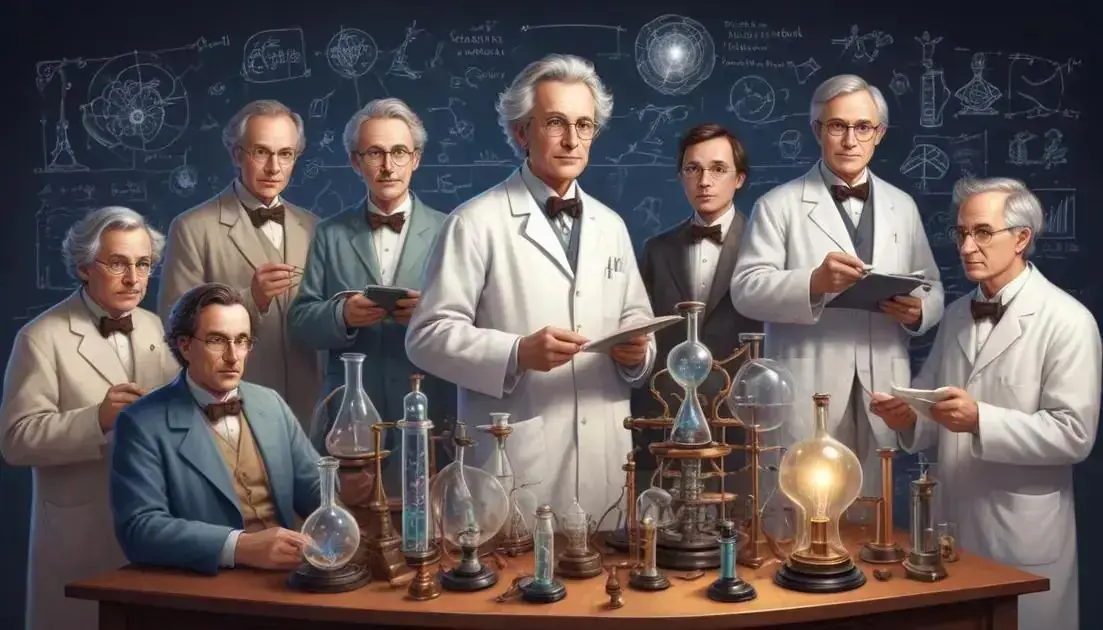
Rivalries that built modern science
Scientific rivalries often drive innovation and highlight the critical lessons learned in the field. Key takeaways include the importance of evidence-based decision-making, the value of collaboration, and the need to respect differing opinions. These conflicts showcase how competition fosters creativity and adaptation, ultimately leading to significant scientific advancements that benefit society as a whole.
In the fascinating world of Science Rivalries, competition often leads to groundbreaking discoveries. How do ego and genius intertwine to shape scientific progress? Let’s dive in!
The Role of Competition in Science
Competition in science has played a crucial role in driving innovation. When scientists face rivals, it often pushes them to achieve more. This race can lead to discoveries that change the world. For instance, the rivalry between Thomas Edison and Nikola Tesla spurred incredible advancements in electricity.
The Benefits of Healthy Competition
Healthy competition can spark creativity. It encourages scientists to think outside the box and explore new ideas. When researchers aim to outdo each other, they often produce work that is groundbreaking. This friendly rivalry can result in faster progress and breakthroughs.
Famous Rivalries that Shaped Science
Many famous figures in science had notable rivalries. The battle between Albert Einstein and Niels Bohr over quantum mechanics is one example that highlights how different ideas can challenge established thoughts. Their debates helped to deepen our understanding of the universe and laid the groundwork for modern physics.
Competition and Collaboration
It’s interesting to note that competition in science often coexists with collaboration. Scientists may compete to publish first, but they also work together. Collaborations can lead to shared knowledge, which ultimately benefits everyone. This blend of rivalry and teamwork drives science forward.
Understanding the role of competition helps us appreciate the amazing achievements in science. It shows how the desire to be the best can lead to incredible discoveries and advancements that benefit society.
Famous Rivalries and Their Impact
Many famous rivalries have shaped the world of science. These battles not only fueled innovation but also sparked significant breakthroughs. One well-known rivalry was between Isaac Newton and Gottfried Wilhelm Leibniz. They competed to develop calculus, each claiming to be the first.
The Impact of the Newton-Leibniz Rivalry
This rivalry stirred major advancements in mathematics. It pushed both men to refine their ideas and methods. As a result, calculus became a foundational tool in various fields, from physics to engineering.
Darwin and Wallace: A Race for Evolution
Another key rivalry was between Charles Darwin and Alfred Russel Wallace. Both men developed theories on evolution independently. Their competition led to the publication of the theory of natural selection. This helped shape our understanding of biology and life on Earth.
Other Influential Rivalries
More modern rivalries, like those between Edison and Tesla, show how competition drives progress. Edison’s direct current system clashed with Tesla’s alternating current system. Their fight helped establish the electrical systems we rely on today.
These famous rivalries tell us that competition can ignite creativity. They highlight how rivalry often leads to remarkable advancements. From mathematics to biology and technology, these scientific battles contribute to our shared knowledge.
Lessons Learned from Scientific Conflicts
Scientific conflicts often teach us valuable lessons. These disputes show how different perspectives can lead to better understanding. One major lesson is about the importance of evidence. In science, facts matter. Scientists must rely on data to back up their claims.
The Value of Collaboration
Another key lesson is the value of collaboration. Conflicts can sometimes spark new partnerships. When scientists work together, they can combine their strengths. This teamwork can lead to breakthroughs that a single person might not achieve alone.
Respecting Different Opinions
Learning to respect different opinions is also crucial. Science is all about questioning and debating ideas. Conflicts can arise from differing views, but healthy debates can help clarify many concepts. Listening to one another can lead to richer discussions and solutions.
Adapting to Change
Science evolves over time. Conflicts often push scientists to adapt and rethink their methods. This ability to change is vital for progress. Staying open-minded can help scientists navigate the complexities of new findings and technologies.
Overall, scientific conflicts aren’t just about winning; they’re about learning and improving our understanding. The lessons learned from these experiences can guide future research and discoveries.
Conclusion
In conclusion, exploring the rivalries and conflicts in science reveals important lessons. Key takeaways include the power of collaboration and the value of evidence-based decisions. Learning to respect different opinions can enhance creativity and lead to breakthroughs. Additionally, adapting to changes is crucial for scientific progress.
By understanding these lessons, we can appreciate how competition fuels innovation. Scientific conflicts aren’t just battles; they are opportunities for growth and learning. Embracing these lessons can help us navigate the complexities of science and inspire future discoveries.
Tags: