The Manhattan Project: building the bomb that ended a war
The Manhattan Project played a crucial role in World War II, leading to the development of the atomic bomb, which transformed global politics and military strategies. Its legacy includes the start of the nuclear age, the arms race during the Cold War, and ongoing challenges regarding nuclear proliferation and international treaties aimed at controlling nuclear weapons. Understanding its implications helps illuminate current tensions in global relations.
Manhattan Project was a monumental American effort that changed the course of history forever. Curious how science intertwined with secrecy to create a weapon of mass destruction? Let’s dive in!
Understanding the Manhattan Project
The Manhattan Project was a secret U.S. government research program during World War II. It aimed to develop the first atomic bomb. Scientists from different fields came together to work on this project. They faced many challenges but were determined to succeed.
Origin of the Project
The project officially started in 1942. Before that, worries about nuclear technology were growing. Scientists like Albert Einstein warned the government about the dangers. They feared that Nazi Germany might create powerful bombs using nuclear energy.
Key Locations
Many important sites contributed to the project. Los Alamos in New Mexico was the main laboratory. Here, scientists worked day and night. Other sites included Oak Ridge, Tennessee and Hanford, Washington. Each location had specific roles in developing the bomb.
Major Figures Involved
Many brilliant minds worked on the Manhattan Project. Some notable scientists included J. Robert Oppenheimer, often called the “father of the atomic bomb.” He led the team at Los Alamos. Others like Enrico Fermi and Richard Feynman also played significant roles.
The First Test
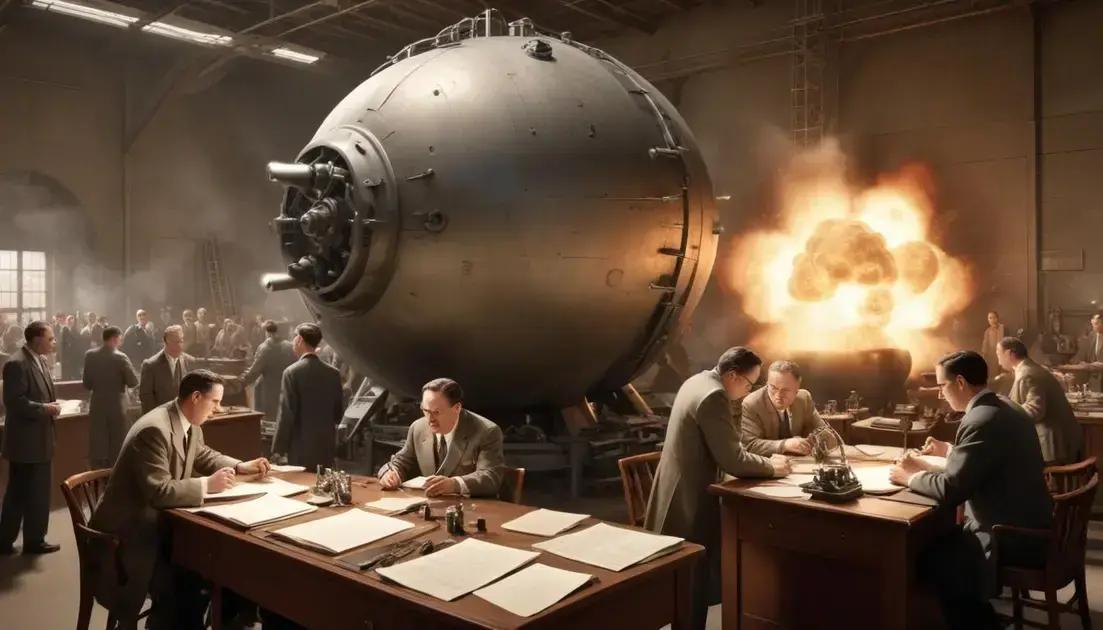
After years of research, the team successfully tested the bomb on July 16, 1945. This test was called “Trinity.” It took place in the New Mexico desert. The explosion created a massive mushroom cloud and confirmed the project’s success.
Impact on the War
Shortly after the test, the first atomic bombs were dropped on Hiroshima and Nagasaki in Japan. These bombings ended World War II but also changed the world forever. They introduced nuclear weapons into warfare and caused huge humanitarian issues.
The science behind the bomb
The science behind the atomic bomb is fascinating and very complex. At its core, it relies on a process called nuclear fission. This is when atoms split apart, releasing a huge amount of energy.
How Fission Works
During fission, a heavy atom, like Uranium-235, absorbs a neutron. This makes the atom unstable, causing it to split into smaller atoms. When it splits, it releases more neutrons and energy. These released neutrons can then hit other atoms, causing them to split as well. This chain reaction creates a massive explosion.
Critical Mass
For an atomic bomb to work, it needs a specific amount of fissile material, called critical mass. This is the minimum amount required to maintain a chain reaction. Too little material won’t trigger an explosion. But with the right amount, the reaction becomes unstoppable.
Types of Bombs
There are mainly two types of atomic bombs. The first is a gun-type bomb. This design shoots one piece of uranium into another, causing fission. The second type is an implosion-type bomb. This uses explosives to compress a sphere of plutonium, increasing the chances of a successful explosion.
The Role of Plutonium
Another key material is plutonium-239. This isotope is created in nuclear reactors and is used in many atomic bombs. It’s efficient and can achieve critical mass in a smaller amount compared to uranium.
The Energy Release
The energy from the explosion comes from the mass-energy equivalence principle defined by Einstein’s famous equation, E=mc². When atoms split, a tiny amount of mass is transformed into enormous energy. This is what makes atomic bombs so powerful.
Secrecy and its implications
Secrecy was a key part of the Manhattan Project. The government needed to keep everything hidden to ensure success. If information leaked, enemies could exploit it. So, strict rules and codes were created to protect vital details.
Security Measures
Many security measures were put in place to protect the project. Only those who needed to know got information. Workers used codenames instead of real names. They weren’t allowed to talk about their work, even with family.
Impact on Research
This secrecy also meant researchers had to work in isolation. Collaboration with outside scientists was rare. While this helped avoid leaks, it made progress harder. Scientists felt frustrated at times due to limited communication.
Ethical Considerations
Secrecy raised ethical questions, too. Many felt uneasy about creating a weapon of mass destruction without public knowledge. The decision to keep such a powerful project hidden affected trust in government.
Aftermath of the Bomb
When the atomic bomb was finally used, it shocked the world. Many people only learned about the Manhattan Project’s true nature after the war. This led to debates about transparency and the role of science in warfare.
Long-term Implications
The secrecy surrounding the project set a precedent. Future military projects often followed the same model. This created a divide between scientists and the public about how nuclear weapons should be handled.
Impact on World War II
The Manhattan Project had a huge impact on World War II. It changed the way wars could be fought. The creation of the atomic bomb was groundbreaking. It introduced a new level of destruction never seen before.
Speeding Up the War’s End
By August 1945, the United States dropped atomic bombs on Hiroshima and Nagasaki. These bombings led to Japan’s surrender just days later. Many believe this quick end saved countless lives. However, it also raised many ethical questions.
Psychological Warfare
The use of atomic bombs sent a strong message to other nations. It showed that the U.S. held tremendous power. This changed how countries viewed military conflict. The sheer destructiveness of the bomb created fear among potential enemies.
Post-War Consequences
After the war, the world faced new challenges. The threat of nuclear weapons became a reality. Countries began to develop their own atomic arsenals. This created tensions during the Cold War.
Legacy of the Project
The legacy of the Manhattan Project is complicated. It brought about a powerful new weapon and ended the war. Yet, it also caused suffering and destruction. The moral dilemmas it raised continue to be discussed today.
Transforming Warfare
The introduction of atomic bombs changed military strategies worldwide. Countries had to rethink their defense plans. Conventional warfare tactics were overshadowed by the threat of nuclear conflict.
Long-term effects on global politics
The Manhattan Project had lasting effects on global politics. The creation of the atomic bomb changed how countries interacted. Nations now had to consider nuclear power in their strategies.
Start of the Nuclear Age
After World War II, the nuclear age began. Countries raced to develop their own nuclear weapons. This arms race created a new kind of tension between nations.
Cold War Dynamics
The Cold War was heavily influenced by nuclear weapons. The United States and the Soviet Union tried to outdo each other. This led to a constant state of fear and competition.
Deterrence Strategy
Nations adopted a strategy called deterrence. The idea was simple: if one country had nuclear weapons, others needed them too. This was meant to prevent large-scale wars but created a dangerous balance.
International Treaties
Over time, countries recognized the need for control. Treaties like the Nuclear Non-Proliferation Treaty (NPT) were created. Such agreements aim to prevent the spread of nuclear weapons.
Ongoing Tensions
Even today, global politics are affected by nuclear capabilities. Countries with nuclear weapons hold significant power. This can lead to conflicts and serious diplomatic challenges.
Conclusion
In conclusion, the Manhattan Project significantly changed the world. Its creation of the atomic bomb impacted global politics, warfare, and international relations. The introduction of nuclear weapons has led to ongoing tensions between nations. Countries now face the challenge of managing these powerful tools while seeking peace.
Today, we still feel the effects of the Manhattan Project. The balance of power has shifted, and nations must navigate complex relationships in a nuclear world. Understanding this history is crucial to making smart choices that promote safety and cooperation among countries.
Tags: