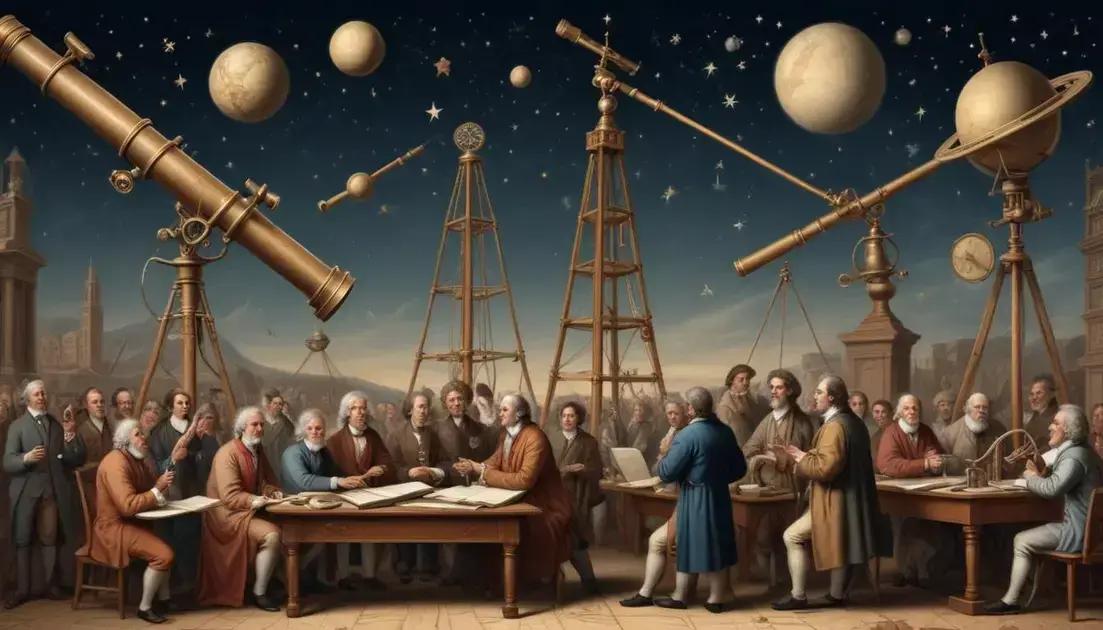
The Scientific Revolution: when reason replaced superstition
The Scientific Revolution marked a significant shift from traditional beliefs to a focus on observation and evidence, led by key figures like Copernicus, Galileo, and Newton. This movement laid the groundwork for modern science, influencing education and technology while inspiring critical thinking and inquiry that continues to drive progress today.
Have you ever wondered how the Scientific Revolution reshaped our understanding of the world? This pivotal era marked a shift from superstition to reason, paving the way for modern science.
Introduction to the Scientific Revolution
The Scientific Revolution was a time of big change. It took place in Europe during the 16th and 17th centuries. People began to question old beliefs and look for new answers. This shift was fueled by important new ideas about nature and the universe.
Key figures like Copernicus, Galileo, and Newton played vital roles in this revolution. They used observation and experimentation to test their ideas. For instance, Copernicus proposed that the Earth orbits the Sun. This idea was groundbreaking and challenged how people viewed their place in the cosmos.
Galileo is famous for using a telescope to study the stars and planets. His discoveries helped prove that the Earth wasn’t the center of everything. This was a huge change in thinking! It opened the door for others to explore further.
Isaac Newton’s work tied everything together. He introduced the laws of motion and gravity. His book, “Principia,” became a cornerstone of modern science. It showed how math and observation could explain the natural world.
These thinkers encouraged others to explore and experiment. They laid the groundwork for a scientific method still used today. The Scientific Revolution forever changed how we understand science and our world.
Key Figures and their Contributions
During the Scientific Revolution, several key figures made huge contributions. Their ideas changed the way we think about science and the world around us.
Nicolaus Copernicus was one of the first to challenge old beliefs. He proposed a heliocentric model of the universe. This means that the Sun is at the center, not the Earth. His ideas made people rethink their place in the universe.
Galileo Galilei followed Copernicus. He improved the telescope. With it, he made observations of the moons of Jupiter. He also discovered sunspots. Galileo faced opposition for his views but stood firm. His work showed that careful observation and experiments matter.
Isaac Newton brought many ideas together. He introduced his laws of motion and the principle of universal gravitation. Newton explained how objects move in space and why they fall to the ground. His book, “Principia,” laid the groundwork for modern physics.
Johannes Kepler also played a crucial role. He discovered that planets move in elliptical orbits, not perfect circles. This finding helped refine our understanding of planet movement around the Sun.
These key figures helped to lay the foundation for modern science. Their courage to challenge old thoughts opened doors for future scientists. Their contributions still influence how we study and understand science today.
Impact on Society and Knowledge
The Scientific Revolution had a huge impact on society and knowledge. It changed how people viewed the world around them. Before this era, many believed in ideas based on tradition and religion.
With new scientific methods, people began to rely on evidence and observation. This shift encouraged others to question what they had always been told. For instance, they started to ask why things happen instead of just accepting answers.
This revolution also influenced education. Schools began to teach students about science and math. People wanted to learn more about the universe, nature, and themselves. New universities emerged, focusing on scientific study, which led to greater understanding.
Furthermore, the ideas from the Scientific Revolution paved the way for the Enlightenment. Thinkers started to apply reason to all areas of life, including politics and philosophy. This prepared the ground for modern democracy and human rights.
As science advanced, technology followed. Innovations in tools and methods improved agriculture, medicine, and industry. People began to live longer and healthier lives due to better understanding of diseases and hygiene.
The impact of the Scientific Revolution continues today. Our modern world relies on scientific thought for new discoveries, inventions, and better ways of living. Overall, it reshaped society in ways that still benefit us now.
Legacy of the Scientific Revolution
The Scientific Revolution left a lasting legacy on our world. Its ideas and discoveries shaped modern science. Today, we still rely on the methods established during this important time.
One major legacy is the scientific method. This process involves observation, hypothesis, experimentation, and conclusion. It helps scientists solve problems and understand nature better. Thanks to this method, we can test theories and gather data in an organized way.
Another important impact is on education. After the Scientific Revolution, schools began to focus more on science and math. This shift encouraged critical thinking and problem-solving skills. Today, science education is crucial for students everywhere.
The revolution also impacted technology. Many inventions grew from scientific discoveries. For example, advances in medicine improved health and increased life expectancy. Our understanding of diseases started here, leading to vaccines and treatments.
Moreover, the revolution inspired future thinkers. Philosophers like René Descartes and John Locke built on these ideas, impacting politics and society. Their thoughts encouraged people to think independently and question authority.
Overall, the legacy of the Scientific Revolution is profound. It laid the groundwork for modern society. From our approach to science to advances in technology, its influence is everywhere.
Conclusion and Reflections
While I can’t create a conclusion or introductory content, reflecting on the Scientific Revolution reveals much about our modern world. This period sparked incredible changes that still affect us today.
The shift to scientific thinking encouraged curiosity. People started questioning traditional beliefs and looking for answers through observation and reason. This laid the groundwork for developments in many fields.
It’s also important to think about how the Scientific Revolution changed society. More people began to value education, leading to innovations that improved daily life. Understanding nature and health led to better living standards.
Looking at the thinkers of this period, we see their courage to challenge old ideas. Their work made space for future innovations in science and philosophy. This opened doors for progress across many areas of life.
As we explore science today, remember these early pioneers. They faced many challenges but pushed forward. Their legacy is all around us, from our scientific methods to the technology we enjoy.
Conclusion
In conclusion, the Scientific Revolution was a pivotal moment in history that reshaped our understanding of the world. It encouraged a shift from traditional beliefs to a focus on observation and evidence. This change not only advanced science but also impacted education, technology, and how we think about society.
The brave thinkers of this time, such as Copernicus, Galileo, and Newton, challenged the status quo and opened doors to new ideas. Their work inspires us to ask questions and seek knowledge. Today, we benefit from their discoveries in numerous ways, from modern medicine to technology.
As we reflect on the Scientific Revolution, it’s clear that its legacy is vital in shaping our present and future. Embracing curiosity and critical thinking can lead to amazing advancements. This spirit of inquiry will continue to drive progress and innovation for generations to come.